Day 1:
Beijing is a huge city with 16 million people (33 million if you add in commuters). It stretches forever, with wide roads that can only be compared to the strip in Vegas. Buildings, with maximum height of 35 floors line the main streets forming what seems to be endless suburban office parks.
We got in late, ordered from room service, instead of going to the 24 hour McDonald’s right down the street, and went to bed. As we have for most of the trip, we are staying in a upper end hotel, this one a Novotel, filled with foreign business people and tourists.
But even here, English is a problem. And the language barrier is SOOO high here. It’s crazy that you can’t even gesture things correctly here. When they are talking or writing you just have NO idea what they are saying. Directions written out in Chinese characters are incomprehensible – do they say the place, which streets to go on? Sometimes our concierge or somebody helping us will write long phrases. Sometimes just two words. Sometimes a cab driver will look at these directions/destination and mumble stuff negatively that I think means they don’t know what is written. Sometimes another cab driver will look at the same writing and say something that seems positive, so we will get in the cab. It’s a complete guessing game. But fun! Always pretty fun.
The hawkers here are brutal. In Cambodia, they were all about “Chicklet?” or “Taxi?”. Here they grab you and tell you about their drink special. Or “Lady Bah”, which we haven’t really heard since Bangkok. Walking down the street, they can be relentless, with one or two following you while new guys come up to you and just grab and yell at you. However, believe it or not, though somewhat annoying, this game of avoidance and “Bu Yao, Che CHe” (no thank you) is quite amusing, at least for the three days we are here.
Day 2: Forbidden City, Temple of Heaven
Now we are talkin’! These are the most impressive sites we have seen on the trip. For good reason. Ankgor Wat was interesting, Guilin and Houlong Bay were beautiful, but Forbidden City (and the Great Wall) are truly amazing. The temples in Bangkok are sizable (especially the giant reclining Buddha) and often works of great achievement, but they were often gaudy and missed the aesthetic mark. These sites, starting with The Temple of Heaven, are truly beautiful. Their Fung Shue (spelling?), their aesthetic, their feel, are breathtaking. The temple of heaven is a cylindrical tower temple where the Yongse Emporer of the Ming Dynasty would come to pray for good crops two times a year. It is beautiful and captures the imagination and craftsmanship of the Chinese people. It was built over 500 years ago of all wood (and is restored about every 25-35 years these days), but has stayed perfectly consistent with the initial design.
And that’s the incredible thing about China- the age and consistency of their heritage. Our tour guide’s family has been in Beijing for 400 years! Holy cow. Through good, bad, strife, war, invasion, 2 dynasties (Ming, Qing) plus Koumintang, and the current communist government; through wars (which killed 10’s of millions), through the cultural revolution (which killed millions), the great leap forward (which killed 30-60 million), though Japanese invasion (which killed millions), through revolution – they have been in the same city. After 18, I have only stayed in the same city for at most 4 years. Um, a little different.
Nothing in a large radius around the Temple of Heaven can be built higher than it, so the view from the courtyard is vast, though the skyline of Beijing is unimpressive – one medium sized, fat office building after another.
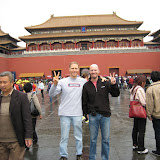
The Forbidden City is massive, with tall front gates and colorful pagoda-like buildings throughout. We entered through the living quarters of the Emperor, where many emperors of Ming and Ching Dynasties had slept. Their quarters included room for their 3000 concubines. Now, though it might sound glamorous, the life of a concubine was, well, not all that attractive. For starters, they are taken from their villages without their choice. They are prepared and trained for 3 years. They spend their lives “pleasing” the emperor, though after every sexual encounter they are told whether to “drink the soup” or not, the soup being a natural birth control mixture (hmmm, marketing opportunity?). If they have children, they get promoted. If they do not, they stay low, without much say in their lives. Their lives are endlessly boring, with nothing really to do but sew and walk around.
When the Emperor dies, it gets worse. If they have not had a son for the emperor, the concubine is buried alive in the tomb of the dead emperor, sometimes with all of the concubine children of the emperor (that are not selected to rule) – so they can serve the emperor in the afterlife. Not really a good deal, eh? The only thing worse is to be a guy who had to take care of the concubines…..can you say eunuch?
The last day, we went to see Ming’s tomb, which actually contains the tombs of 14 emperors since the 15 century. Tranquil, guarded by huge limestone statues of lions, elephants, dragons, and others, the tomb is just the top of tombs that lie 100’s of feet below the ground. All tombs except for one have been left intact, unopened because of fear that the low water level would force water to rush in and destroy the contents, as it did for the one tomb that was opened in the 1930’s. What’s most impressive is that though the Japanese and communists sought to destroy all things old and Chinese, these things were, for the most part, untouched (or able to be rebuilt). The limestone statues are so hard at Ming’s tomb, that Japanese soldiers who tried to cut into them were unsuccessful and they remain intact.
Next on the tour of the Forbidden City was the living quarters, complete with actual furniture. The first thing that strikes you is, though the forbidden city is vast, with 9999 rooms (well, not exactly “rooms”, but “rooms” where a room is defined as an area surrounded by 4 pillars), the actual furniture of the Emperor was small and the bed wasn’t even a king sized bed, it was more like a Full. The irony. All the power in the world, 3000 concubines….and a small bed.
Many of the items in the Forbidden City and in the Summer Palace were greatly enhanced or change by the Dowager Empress – a pretty bad ruler who started as the head concubine for a Ching Emperor, and then, upon his death, was the mother of his only son. She controlled her son, and then once he died, the nephew (who she eventually killed) and finally, “the Last Emperor” of movie fame. She is blamed for single-handedly ruining the empire and expediting the fall of the monarchy. Her classic dumb move was taking a large amount of the navy’s budget and spending it building a huge marble boat at the Summer Palace. Nice job.
The central court of the Forbidden City is expansive and beautiful. Leaving it through the main entrance, you reach Tianneman Square, which is militaristic and impressive. In the middle sits the Mao Mausoleum and the whole thing looks like a much bigger version of the Ho Chi Minh Mausoleum area in Hanoi. Embalming was all the craze with founding Communist dictators. Its big. There are a lot of people there. We asked our tour guide about the protests n 1989. They obviously did not see them on TV, but in her 1000s of tours of American’s, she has learned all about it and even knows where the famous tank scene was.
Which leads me into the most important discussion of all. It’s not communist. I have no idea what pinko ideas they started with, but China is NOT communist. They might be a one-party dictatorship. They might have total control to take and appropriate land and hotel rooms. The telephone company, airline, trains, taxi’s, apartment buildings, etc. might all be owned by the state. But this is NOT a communist country. Everything here is as capitalistic as you could imagine. From the hawking of copied DVDs to the very nature to the huge supermarkets (these ain’t no Russian bread lines, these are fully stocked markets that put Publix to shame) this country is letting its people earn their livings through free markets. Also, the internet has opened up freedom of speech for most, with almost all the citizens able to log onto CNN or yahoo in Chinese and reading criticisms of the government in their native tongue. However, there are still some remnants of the socialist way of life, and capitalism brings with it many bag things – a growing discrepancy between the wealthy and abject poor, etc. We’ll see where they wind up.
The Summer Palace was the most beautiful palace of all, integrated perfectly into nature. It was about 20 km from the other palaces, in an area that, just 20 years ago, was rice fields and now is built up. But the gigantic man-made lake, man-made hill and luxurious pogado’s and temples made this site calming, beautiful and interesting. It’s also the location of the famed marble boat. Ugh.
Nightlife in Beijing
At night, we went to the Sanliturn Bar Street, recommended in Lonely planet as a ex-pat and tourist hangout. Except for amazingly annoying hawkers, on this Monday night, it was close to abandoned. However, after eating an OK dinner where the restaurant tried to charge us $15 for tea (remember, this is China where tea is most of the time free), we explored some more empty bars. We went to one bar that was supposedly on weekends so crowded, you had to grease yourself us to get to the bar to order a drink. It had three locals in it.
We then went to Yao Club, a Chinese dance club, where we were the ONLY westerners. By the difficulty we had ordering drinks, I would guess it had been 6 months since they had served a Westerner. While we were there, other Caucasians walked in….and then walked out – I would guess to be the usual situation.
However, having practiced our “Dominate on the Dance floor” routine in Yangshou, we were ready. Here, though, nobody was even really looking at us. No Hawkers. No “hello sir”. We made our way up to the dance floor which had about 15 woman and 1 guy dancing. Guys in Asia don’t know how to dance and don’t dance. Woman for the most part at least move a bit, but wouldn’t win any dancing contests in the states. I started dancing, Glenn started his controlled flail and we were off. Within seconds, the woman crowded around us. I chose a scantily clad, somewhat attractive local and we danced for about 15 minutes, getting progressively more dirty. I was a bit reserved in the beginning, but, as I learned, the shy ones can get quite crazy when given the chance. Jo-Jo (obviously Englisized) knew a bit of English, and after our dirty dancing session, we went to the bar with Glenn and his chick (a friend of Jo-Jo’s) to grab a drink. We talked for a bit, but it got. Neither Glenn nor I wanted to close on our prospects, so we left.
We were going to go home when we ran into 4 French students from Dauphin University who were going to meet up with their gang at Shooters. I instantly clicked with Catherine, an attractive Brunette. After walking around a bit, and getting some good footage of the Hawkers, we went over to Shooters and hung out with 20 fun Frenchies (who would have thought). Included in the wild dancing, was $1 shots all night long (which helped).
Day 3: The Great Wall
We went to a closest section of the wall to Beijing, which had LOTS of tourist stuff around it. Much of this part of the wall had been rebuilt from the original 400 BC stuff in the 15th century by the Ming. It was not a flat part, but a steep climbing wall with over 1000 steps leading to impressive views. It was both inspirational and physical challenging. The wall is the ultimate feat of man – 6,000,000 people worked on it for decades. Its height, solidness and relative success (it did protect the border for a significant amount of time) was unmatched in history. Though each small section is no grander than any other old wall (think Israel, Greece, Rome, Cambodia, etc.) in aggregate it is breathtaking.
We arrived at the wall at about 11:00. This section goes around in a circle, with other connecting parts destroyed and not rebuilt until. The next section of Wall were over the ridges on both sides. So when you are climbing it and you get to the top, you are in essence at a dead end.
Through the climb, we learned a trite, old lesson, in the best way we could have ever done so. It’s been told at least a billion times, but I have never seen such a clear example. I think its relevant to our task. Glenn and I visited the Great Wall a few days ago. Our site along the wall was on a hill, and to walk on the wall, you had to climb about 1300 steps. I am in pretty good shape now, so we began fast, passing people as we went up. We passed this one guy who was going slowly. After a few watch towers, we needed to rest, then we sped up and then needed to rest some more as we inevitably got tired. We were motivating each other to go up, pushing harder. But it was tough work. It was not too long until the slow guy, walking perfectly meticulously, not speeding up on the easy steps, not slowing down on the steep steps, passed us. We sped up and passed him, but sure enough, his turtle beat our hare and eventually he was way ahead of us.
Tired, emotional, panting, sore, we finally slowed down and imitated the guy. We walked deliberately and slowly, always at the same slow, but consistent pace. We began passing people. We weren’t panting, we weren’t sweating. We were no longer sore. We no longer need to hype up our emotions. We just kept moving forward. Now that we weren’t focusing all our energy on just getting up the stairs, we started talking to each, noticing that we were really on the Great Wall and had a great time.
Meanwhile, there were some young kids that kept passing us in the beginning of this exercise. Sure enough, we made it to the top long before they (panting) did.
Upcoming in business, I am my partners have a very high wall to climb. The only way to do it is through the slowest, most deliberate execution of the mundane. I now see how that should be done. No exasperation. No emotion. No sprinting. Just the slow, meticulous, emotionless execution of the long slow hike.
The third night we went to dinner and then stayed in, getting rest in preparation for Tokyo.