 |
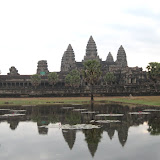
| Angkor Wat Cambodia |
Leaving Cambodia. Doesn’t quit have the ring as “Leaving Las Vegas”, but it feels much the same. You leave disquieted, as if exposed. I am also feeling a bit sick, so that could be messing with my mind a bit. Nothing like a little Deng Fever to brighten up your trip, especially when you won’t be in a first world country for another 3 weeks. Granted, my appetite for discomfort and sickness is probably a little lower than the next guy’s, but this place is truly close to the bottom of the international socio-economic ladder. Decades of war, drought, political unrest and really, really bad leaders have decimated the people, left a population without intellectuals (they were targeted by Pol Pot), and left tens of thousands without limbs. The country, finally finished with the Kamr Rouge in 1998, has now had a decade to slowly rebuild. Suppedly, 1 million people visited last year, throwing what I estimate to be $300 million into the economy – or about $20 for every man, woman and child. Tourism is beginning to grow, and the city of Siem Reap is building like crazy, with now a whopping 60 hotels, some of them pretty nice.
But Siem Reap is worth it because it’s close proximity to Angkor What and a myriad of other temples. They are worth the trip. They are worth the mosquitoes, they are worth the hundreds of children hocking books and fans to you as you walk down the street (‘Scuse me Sir, Wer you from? Germany? Tell me where you from and I tell you the capital? Do you want a Postcard? Sir? How are you? Sir), they are worth the 105 degree heat, they are worth the endless dirt and stench.
Most of the temples were built during the Hindu period (800-1200 CE) and the Buddhist period (1200-1300 E). The origins of these people come from 700 years before, as Chinese and Indians began forging trade routes through Cambodia, Vietnam and Laos to the middle east, bringing with them money, spices and religion. The people in Cambodia and surrounds adopted a range of these thinkings, but by 800, the a Hindu King rose to power, and with his domination began to build the most impressive of the temples in the area. Angkor What, with its immense three towers and miles of stone stands, was build 300 years later, a pinnacle of these achievements. Its massive moat surrounds the structure. We arrived there at 5:30 AM, to be there in time to see the sun rise over the towers. Walking the 300 meter bridge across the mote in the almost total darkness is an enchanting experience. The first signs of dark bluish light hint at the outlines of water and land, tree and sky. In front of us is the outer wall, 20 feet high and wrapping as far as the hindered eye can see in both directions.
We enter the Temple, through the front gate, which faces west, signifying that this structure is, like the temples of Egypt, a giant crypt for a great leader. Suryavarman II constructed Angkor Wat in the form of a massive ‘temple-mountain’ in 1170 AD and dedicated it to the Hindu god, Vishnu. Though this was also a state temple, most think its primary purpose was funerary. The exterior wall is 1300 X 1500 meters. It is huge.
Around the inner temple are Bas-reliefs telling of the historic battles, both real and mythological. The one commonly referred to tale is of the demons and the gods working together to churn Vishnu in the Ocean Milk to produce immortality for the gods (it took them 1000 years of churning to get their result).
Not only visually inspiring, the temple is also physically challenging. The steps to the top make the Ann Frank steps in Holland seem long a luxurious. Almost straight up, these steps go for 3 stories into the sky and are pretty scary to climb. I went up them, but came down on the south side that had hand rails. Only afterwards was I told that people have died falling down the stairs. Um, maybe they should have had better planning on the steps.
We saw three other temples in Cambodia. Angkor Thom, a 3 KM walled royal city built by Jayavarman VII after he recaptured Angkor from the Cham in 1181. J VII went to Champra to win a great victory against the Cham which took four years. However, when he came back after the war, the Cham had snuck around and taken Angkor, his capital, while he was away. He then fought the Cham and defeated them on his own territory, enslaving them and making them build this city. One of the most artistically impressive temples in Angkor Thom was Bayon, a smaller temple known for 50 towers, each with four huge smiling Buddha/Jayavarman faces. Very cool stuff. If you were a face sculptor, you had no want for work back in the Jayavarman days. Also in our tours, was Ta Prohm, another Jayavarman VII temple that now has trees growning through the actual buildings. It was the place of one of the Tomb Raider (starring Angelina Jolie) scenes. Very cool stuff.
The social scene in Siem Reap revolves around “Pub Street”, with at least two dozen bars and restaurants catering to tourists. Temple Bar is pretty much the center of this scene, which is almost British Colonialist seeming, with whites taking tea in the shade, as locals scurry around serving, tuck-tuck (open air taxi’s pulled by moped) racing by. For a place far away from the reality we all know, this place was friendly, warm and fun.
The first day in Cambodia, we met Alicia, an Australian from Sydney, traveling for two weeks in Cambodia. She had stayed with friends in Phnom Phen (the capital) and had also visited the beaches down south. A challenging trip, but one she had enjoyed. We had heard from others that Phnom Phen was almost unendurable, but she did not agree. To each their own.
We spent most of the days in our hotel, avoiding the heat and since there was not much to do in Siem Reap, except drink at night.