Just finished “The Future of Freedom”, by Fareed Zakaria, which lays out an unintuitive truth: Democracy is good, to a point. More democracy, more say, more control actually has lead to the fall of countries, institutions and professions. The elite of yesteryear (dictators, smokey-roomed political puppeteers, blue-blooded investment bankers) were far from perfect, but their ultra-reformed, ultra-democrative replacements are paralyzed by endless accountability and pandering to thousands upon thousands of individual and minority interests. The “Nobless Oblige” of leaders has been replaced, in institutions throughout the world, with the incoherent ramblings of the unwashed masses.
Zakaria assumes from the beginning that democracy is good. When used correctly, it is the ultimate in legitimate government and control. Democratization of politics has lead to every American being able to vote, and of economics has lead to every American able to invest in stocks and access high returns. When implemented correctly, with the right characteristics and checks and balances, democracy and democritization provides the people control of their government and institutions and affords long term sustainability. This he says is the right democracy – Liberal (constitutional) democracy. Britain and the US, much of the West, have created democracy checked by a constitution, multiple controlling factions, political parties and indirect voting. These and other controls neutralize the inherent destroyers of democracy: nationalism, religious zealotry, extremism.
But what of reality. Zakaria handles democracy, it’s blessings and curses, on three different levels: Global, national and institutional/professional. In each case, he points out the democratization can be good, but also, lead to less control, less openness and decrease in satisfaction. Our tendency on the last 40 years has been to slowly, but surely, go overboard and reduce the effectiveness of our needed institutions.
For nations, democracy has its limited place. “Democracy” describes only the mechanics by which leaders are selected and decisions are made. The nature of protections in the society, the freedoms of the people, the rights to free speech, practice of religion, protections from search and seizure are all determined by the nature of the laws – whether they are liberal or illiberal. Dictatorial regimes can provide a more liberal society than democratic ones – as in the case of Singapore where its dictatorial leader upholds a rule of law providing for many of the freedoms we associate with modern democracies.
Furthermore, to arrive finally at democracy, most countries must go through a “twisted path”, a long period where they build up the institutions and wealth that will make their transition to democracy possible. Countries like Vietnam and China are controlled by regimes that are far from completely free, but provide important protections for the growth of commerce. This expansion of commerce is a critical leg in the creation of the checks and balances needed for democracy to evolve. For countries with over $6000 per capita income, with a strong established business class (bourgeous) and independent religious institution, the switch from monarchy or dictatorship to constitutional democracy can be painful but successful. What these countries have are institutions, separate from the government, that fight for liberal freedoms – checking the control of the government, pushing reforms and slowly pushing states towards democracies. We see this being created in Vietnam, China and Russia.
Zakaria wrote the book before the invasion of Iraq, but predicted with haunting accuracy the problems of pushing democracy on a society without the necessary institutions, economy or fundamental understanding of it. Now, we are fighting against the nationalism, hate and racisms that often bubbles to the surface in under-formed democracies. Politicians, hungry for power, resort to religious and nationalist issues to gain support, dividing the populous and pushing people towards radical views – Think Germany in 1930’s. The ultimate example of the illiberal nature of democracy is when Greeks voted to hang Socrates, one of the most brilliant minds in history.
Just as checks and balances and limiting democracy is necessary in government, Zakaria goes though numerous other examples of how too much control can destroy. His most meaningful example is politics, where he talks about how, since the “democratization” of congress through the sunshine laws, all lobbyists can see each and every individual vote of each congress person. Even the framers of the constitution saw this as a massive danger and put some protections in our system for this. But with the elimination of these changes, the inmates now run the nuthouse. And what has ensued is the terrible fear that any congress person has of cutting any budget items, fearful that lobbyists will find out and not give them necessary funds to get re-elected. As a result – deadlock in congress and no spending cuts in the last 20 years.
Overall, a strong book and well worth reading.
Monday, January 29, 2007

Friday, January 26, 2007
Believing in Nerphs
I just finished watching “Lady in the water”, a much better movie than expected. M. Night Shyamalan does not resort to the final “gotcha ya” moment – a dead man walking, a friend turned madman villain, a old home town revealed as an isolated experiment in a new age. This movie was about the dream – to be childlike (satired by Paul Giamatti on a couch, curled up in fetile position, milk dripping from his face, awaiting the next chapter of the fairy tale story) and belief.
It’s about believing that there are things in life that are more than what appears on the hard surface we expect; and finding your rightful place in this more complex, but rewarding order. Mathieu Ricard says ignorance is not being able to see life for what it really is. Buddism teaches that reality is being able to see the world undisturbed, without spin and distortion. In most of our lives, we assign all things arbitrary titles and attributes like “good” and “bad”, “I” and “them”. The world, in reality, is pure and unjudged, flowing without these assignments and qualitative evaluations. The happiest people (and most successful investors) have the ability to blow away the fog, and look clearly at the light. To see things as they really are.
As I continue to reach for more fulfillment, reality becomes more bare. Fear can take over or optimism, revealing all the opportunity for amazing journey and possibility that lies ahead. Its a battle. I have a friend who refuses to see the opportunity that I see for him. He is blind and spends his days hating himself, his past, his future. But, for me, even just saying the words - that the future has so much promise - letting them ring out, brings them finally to the forefront. They are absolutely true. Its too often said and simultaneously ignored: This IS the only life we are ever going to lead and fulfillment no greater than mere acceptance is only our own fault.
So much is spoken and written about fulfillment. The way I imagine it will one day feel like was described by Ricard and spoken about by Covey: when things feel right, at ease. When the noise, fear and distraction fade away and all of sudden quiet serenity shines through. Just a few hours ago, I was sitting at Mizner Park, battling the cacophony from two dueling bands; the strenuous life; the staring people. And, stopping, breathing deeply, I felt a peace come over me. Think that moment, from Wicker Park, when Matthew (Hartnett) finally sees Lisa (Diane Kruger) – the silence, commotion, estrangement, longing at last fading to “The Scientist”:
“Come up to meet ya, tell you I'm sorry
You don't know how lovely you are….”
In that moment, the brightness of color, I felt reborn. A moment of the quieting of anxiety and endless noise of life. The feeling is best described as being comfortable with where I was, who I was, and where I was going. That could be something close to happiness, fulfillment.
So that’s what I have to go on so far. Closing in on 35 years now. Just a few days away. But, even though that’s all I got so far in the semester, I think I am ahead of the class. Next, I am working on believing in Nerphs. I will talk to a Yogi in a few months about that one, it might be a bit tougher.
It’s about believing that there are things in life that are more than what appears on the hard surface we expect; and finding your rightful place in this more complex, but rewarding order. Mathieu Ricard says ignorance is not being able to see life for what it really is. Buddism teaches that reality is being able to see the world undisturbed, without spin and distortion. In most of our lives, we assign all things arbitrary titles and attributes like “good” and “bad”, “I” and “them”. The world, in reality, is pure and unjudged, flowing without these assignments and qualitative evaluations. The happiest people (and most successful investors) have the ability to blow away the fog, and look clearly at the light. To see things as they really are.
As I continue to reach for more fulfillment, reality becomes more bare. Fear can take over or optimism, revealing all the opportunity for amazing journey and possibility that lies ahead. Its a battle. I have a friend who refuses to see the opportunity that I see for him. He is blind and spends his days hating himself, his past, his future. But, for me, even just saying the words - that the future has so much promise - letting them ring out, brings them finally to the forefront. They are absolutely true. Its too often said and simultaneously ignored: This IS the only life we are ever going to lead and fulfillment no greater than mere acceptance is only our own fault.
So much is spoken and written about fulfillment. The way I imagine it will one day feel like was described by Ricard and spoken about by Covey: when things feel right, at ease. When the noise, fear and distraction fade away and all of sudden quiet serenity shines through. Just a few hours ago, I was sitting at Mizner Park, battling the cacophony from two dueling bands; the strenuous life; the staring people. And, stopping, breathing deeply, I felt a peace come over me. Think that moment, from Wicker Park, when Matthew (Hartnett) finally sees Lisa (Diane Kruger) – the silence, commotion, estrangement, longing at last fading to “The Scientist”:
“Come up to meet ya, tell you I'm sorry
You don't know how lovely you are….”
In that moment, the brightness of color, I felt reborn. A moment of the quieting of anxiety and endless noise of life. The feeling is best described as being comfortable with where I was, who I was, and where I was going. That could be something close to happiness, fulfillment.
So that’s what I have to go on so far. Closing in on 35 years now. Just a few days away. But, even though that’s all I got so far in the semester, I think I am ahead of the class. Next, I am working on believing in Nerphs. I will talk to a Yogi in a few months about that one, it might be a bit tougher.
Thursday, January 18, 2007
Never Eat Alone
"Never Eat Alone", By Keith Farrazzi
Do you lead a connected life, Keith Farrazzi asks. Keith states that the value of our lives is measured in the number and quality of connections we have to others and the degree to which we positively affect our friends, colleagues, family and the world. To achieve a fulfilling life, we much challenge ourselves to reach out to people in reciprocal relationships (mentee/mentor, friendship, peer) whereby one offers to the other assistance and value before asking for the same in return.
To reach out and establish bonds with others, you must (1) share of yourself and provide valuable content. Being interesting means having interests and pursuing them, and sharing them with others. Farrazzi describes it as thinking of yourself as a brand – understanding what the brand stands, crafting it to be true to yourself and effective and marketing that brand successfully through a sprectrum of media and interactions. (2) Be humble and appreciative of help. Always look to help others – you will only achieve your goals if you first have helped everyone around you achieve theirs, (3) Reach out to new people and incorporate them into your life and goals. For each goal in business, social or life, ask yourself who could be helpful and create a strategy and dedication to meeting and helping those people and bringing them into your social network (4) Respond to the things the people in your network, or those you are bringing into your network, really care about – summarized by Michael Milken as “Health, Wealth and Children”. Helping in any of these areas can quickly help you create strong bonds with people. (5) Don’t keep score – it’s not a zero-sum game. Helping others is a satisfying, pie-growing activity.
Keith gives stories about his fabulous intimate dinners parties that he crafts as well as techniques on optimizing the use of conferences, how to engage in small talk, appropriate methods of follow-up (follow-up, follow-up!), and other bare-bones networking techniques
But what pervades his book is the meaningfulness of his own story. He doesn’t really tell you about networking as much as he shows you about networking. In one anecdote, he tells of his successful stint as Chief Marketing Officer at Ya Ya (an advergaming company). Through networking strategically, he was able to form meaningful connections with the power-brokers of the media, gaming and entertainment fields. It was these connections that allowed the company to move from being the industry underdog to leader in a few short years.
And through Keith’s stories, it becomes even more apparent that what the reader responds to is the “brand” and “story” of Keith. A rags to riches, underdog to victor story that is inspiring to me to “get out there”, make a plan and start creating a truly connected life.
Do you lead a connected life, Keith Farrazzi asks. Keith states that the value of our lives is measured in the number and quality of connections we have to others and the degree to which we positively affect our friends, colleagues, family and the world. To achieve a fulfilling life, we much challenge ourselves to reach out to people in reciprocal relationships (mentee/mentor, friendship, peer) whereby one offers to the other assistance and value before asking for the same in return.
To reach out and establish bonds with others, you must (1) share of yourself and provide valuable content. Being interesting means having interests and pursuing them, and sharing them with others. Farrazzi describes it as thinking of yourself as a brand – understanding what the brand stands, crafting it to be true to yourself and effective and marketing that brand successfully through a sprectrum of media and interactions. (2) Be humble and appreciative of help. Always look to help others – you will only achieve your goals if you first have helped everyone around you achieve theirs, (3) Reach out to new people and incorporate them into your life and goals. For each goal in business, social or life, ask yourself who could be helpful and create a strategy and dedication to meeting and helping those people and bringing them into your social network (4) Respond to the things the people in your network, or those you are bringing into your network, really care about – summarized by Michael Milken as “Health, Wealth and Children”. Helping in any of these areas can quickly help you create strong bonds with people. (5) Don’t keep score – it’s not a zero-sum game. Helping others is a satisfying, pie-growing activity.
Keith gives stories about his fabulous intimate dinners parties that he crafts as well as techniques on optimizing the use of conferences, how to engage in small talk, appropriate methods of follow-up (follow-up, follow-up!), and other bare-bones networking techniques
But what pervades his book is the meaningfulness of his own story. He doesn’t really tell you about networking as much as he shows you about networking. In one anecdote, he tells of his successful stint as Chief Marketing Officer at Ya Ya (an advergaming company). Through networking strategically, he was able to form meaningful connections with the power-brokers of the media, gaming and entertainment fields. It was these connections that allowed the company to move from being the industry underdog to leader in a few short years.
And through Keith’s stories, it becomes even more apparent that what the reader responds to is the “brand” and “story” of Keith. A rags to riches, underdog to victor story that is inspiring to me to “get out there”, make a plan and start creating a truly connected life.
Tuesday, January 16, 2007
An Night Evening
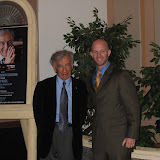
"Life is not made up of years, but of moments" - Elie Wiesel. We think of life as contiguous, as streaming by, but in memory, it is less movie and more picture - frozen images, feelings, sensations that, like a pointillistic illusion, come together to form our past. Perhaps it’s a childhood victory, a first kiss, a tragic event, a life-changing revelation. Perhaps it’s just a smell, a song, a moment not to forgotten, etched into the cerebrum forever. These points are the ticket stubs of our lives, and make up the scrap book that will guide us into the unknown. But we can’t simply rest on these past images.
Elie points out that though history books are filled with the long and storied of our people, that we have an even better future. We care. We have hope. The Talmud, he recalls, says that, though our first focus of tzedaka must always be to our own family and village, we are not released from the responsibility of helping others. From Cambodia to Harlem, Elie Wiesel has been there. In his words - "When we needed others, they were not there. So it our imperative to be there for others that need our help".
Looking around the room it’s hard to imagine the reality of fear that penetrated our people throughout history. Chrystal Nacht, the subject of "Night", can only resonate so much with people who have never known true fear. Even when Elie Wiesel talks of Ahmadinejad and the atrocities he had publicly announced he wants to commit, the fear does not register as immediate, pertinent or real. But Elie Wiesel, standing up, knows a different reality. We should listen.
Friday, January 12, 2007
A good beginning
All groundbreaking journey's should begin with a meaningfulul christening. I feel like the luckiest guy in the world, having got to spend my send off with friends and family.
The Kegger at Woolbright included all the favs. We had platters like a good Bar Mitzvah and lots of cheese and broccoli. If we had had a bigger keg and more time to drink, we would have most likely seen Liz Hoyer doing a few keg stands (followed behind by Soraya, who I am sure was just waiting for the opportunity.)
Pictures:

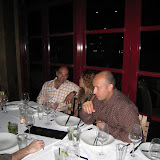
The China grill dinner grew over the top, with the South Beach crew in full force partying it up with the fam. In the end, 20 people (to the Chagrin of restaurant management) ate, drank and made Boiler Room toasts. It was a three hour, laugh out loud amazing affair. Thanks to all who attended and much more fun in the future.
Pictures:
Subscribe to:
Posts (Atom)